Music as identity and expression
On Chesil BeachMusic as identity and expression is a defining dimension of Florence Ponting’s character and a recurring structure in her relationship with Edward Mayhew. Her work with the Ennismore Quartet gives her a demanding vocation and a means of exercising judgment; it also becomes the language in which she imagines love without surrendering independence. The music’s recurring questions and answers illuminate a contrast the relationship cannot resolve: Florence can create understanding through disciplined collaboration, but she and Edward struggle to speak plainly about what they want.
The Mozart phrase and Florence’s resolve
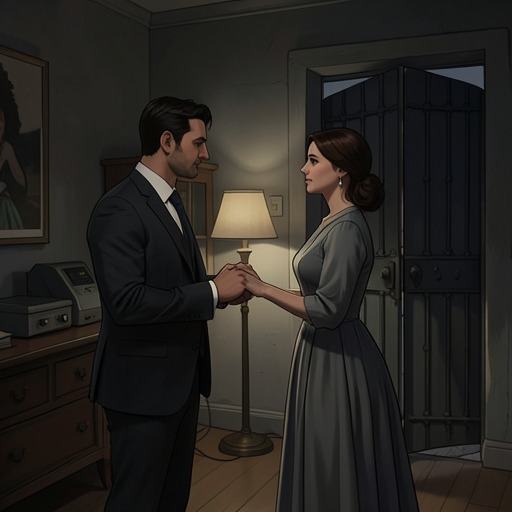
At the beginning of the wedding-night bedroom scene, Florence hears a familiar musical phrase in memory: four rising notes from the opening of a Mozart quintet. In her recollection, the cello seems to pose a tentative question, while the other instruments offer lingering, doubtful replies. The phrase has no words or specific verbal content; it is, in effect, an enquiry reduced to a question mark. This musical image gives the scene a form for uncertainty just as Florence is trying to decide what she wants to say to Edward.
The quintet is connected to a prior dispute within the Ennismore Quartet. Performing it required bringing in an additional viola player, a complication Florence’s friends would have preferred to avoid. She insisted on the piece, invited a fellow student to rehearse with them, and saw the ensemble come to value it. The group’s musical exchange thus recalls Florence’s capacity to hold to her judgment even when she is outnumbered.
As she delays and sets down her shoes, that memory reminds Florence of another aspect of herself: the musician who leads her quartet is not someone who will meekly accept conventional expectations. She intends to speak with Edward, state what she does and does not want from their marriage, and seek a compromise that does not make one partner’s desires come at the other’s expense. Music here does not supply an answer to the couple’s conflict; it helps Florence recognize that she has a voice and that she intends to use it. When Edward approaches, however, the thought and its promise of action disappear.
A vocation with its own demands
Florence’s musical identity is established through the seriousness of her ambitions for the Ennismore Quartet. After the group plays Beethoven’s Razumovsky for its tutor, he tells the players they have a future and urges them to remain together and work hard. He recommends that they concentrate first on Haydn, Mozart, Beethoven, and Schubert, setting aside later composers until they have developed their repertoire. Florence sees the quartet not as a temporary interest but as the life she wants: she cannot bear the prospect of spending her years at a rear desk in an orchestra, even if she could obtain such a position.
What matters to her is the work’s combination of concentration, difficulty, and discovery. Each player has something of the responsibility of a soloist, yet the musicians must make the ensemble cohere. Florence explains that repeated work on a piece can reveal something new each time. Her aspiration is therefore both individual and collaborative: she leads, makes decisions, and pursues excellence, but the music becomes possible through the effort of friends working together.
The Wigmore Hall embodies the public future she imagines for that work. When she brings Edward there, she shows him the auditorium and stage and asks him to imagine the challenge of performing before an audience. She is certain that the Ennismore Quartet will one day play there. Edward cannot fully share her sense of what the hall means, but he responds to the solemnity of her promise by choosing seat 9C and pledging to lead the applause. The place and seat become a shared future expressed in different ways: Florence imagines artistic achievement, while Edward imagines being present to witness it.
Edward learns to listen
The distance between Florence’s vocation and Edward’s tastes is initially pronounced. Classical music means little to him, and he regards it as an indistinct background sound associated with seriousness and respect for the past. Yet music also marks moments when his attachment to Florence becomes newly expressible. At her home in Oxford, she plays Mozart’s Haffner Symphony on a stereophonic record player. The experience moves him to declare his love for her, the first time he has said it to anyone. Florence is delighted not only by the declaration but by the fact that he has finally been moved by a piece of classical music.
Edward’s response remains uneven. At a rehearsal, he is first struck by the sound of the instruments, then loses interest, and gradually begins to notice melodies and exchanges among the players as the musicians repeat the passage and Florence gives them notes. This change is limited but genuine: on the journey home, he can tell her honestly that the music moved him and hum parts of it. Florence promises that the quintet will be played for him when the quartet makes its Wigmore Hall debut. Her promise joins his new attention to music with the future performance she has already imagined.
Their musical exchange also reveals a difference rather than overcoming it. Edward brings Florence recordings of Chuck Berry and songs performed by the Beatles and the Rolling Stones. She listens patiently, finds one song amusing, and tries to respond appreciatively, but dislikes the drumming and questions its purpose when the music already has other sources of rhythm. Edward recognizes that she does not share his response to rock and roll. The contrast is affectionate, but it shows that intimacy does not require identical taste—and that listening, for both of them, involves trying to enter a world the other does not inhabit naturally.
Music as a language of freedom
At the crisis on Chesil Beach, Florence imagines the life she would rather be living in concrete musical terms: travelling from Oxford to a quartet rehearsal with her violin, music, and pencils, towards difficult work with friends on problems they can resolve together. Against that image, her conversation with Edward seems to offer no resolution she can see. The contrast is not simply between career and marriage. It is between a form of collaboration in which differences can be worked through and a relationship in which she cannot find the courage to state her proposal.
When she eventually explains what she wants, she imagines a life with Edward that would also leave room for her music. She says that she wants to be with him, care for him, and work with the quartet, with the hope of someday playing something beautiful for him at the Wigmore Hall. Her proposed arrangement is grounded in love but rejects the assumption that love must make the couple conform to a single conventional pattern. Music gives her a way to express what she hopes their shared life can contain: affection without abandoning her vocation, and closeness without giving up the freedom to play.
Edward misunderstands the proposal as permission for him to be with other women. That response exposes the limits of music as a bridge between them: Florence can imagine and articulate a life organized around both love and independence, but the couple cannot translate their different expectations into a mutually understood agreement. The earlier quintet’s question-and-answer pattern therefore carries an unresolved force. Its replies may be heard and revised through rehearsal; the couple’s exchange does not achieve comparable accord.
The performance and its absent witness
The Ennismore Quartet eventually makes its Wigmore Hall debut in July 1968 and receives a triumphant reception. A newspaper critic praises the young ensemble’s playing and singles out Florence, the first violinist, for the expressive quality of her performance. The realization of her ambition confirms that the musical future she described to Edward was not an idle fantasy: the quartet reaches the hall she had led him through, and she performs there as its leader.
Edward, by then absorbed in a different life and no longer following classical music, never hears of the concert or its reviews. During the applause, Florence’s gaze travels to the middle of the third row, to seat 9C. The detail brings the earlier promise back at the moment of her professional success: Edward had imagined himself there, ready to applaud, but is not present and does not know what he has missed. Music has carried Florence toward the public achievement she sought, while the seat preserves the private future she once imagined sharing with him. Its significance lies in both outcomes at once: her artistic identity endures and succeeds, but the hoped-for witness to that success remains absent.